
High-end jewellery demands visuals that sparkle as vividly as the pieces themselves. Yet traditional photoshoots can be slow, costly, and hard to scale when collections refresh rapidly or product details change last minute. A modern jewellery content creation tool powered by AI reshapes production by converting sketches, CAD files, or product photos into photoreal imagery across e-commerce, social, and print. The result is faster launches, consistent brand storytelling, and visuals sharp enough to honor every facet, cut, and polish.
Why Modern Jewellery Brands Need an AI-Powered Content Creation Tool Now
Today’s jewellery shoppers judge quality in milliseconds. They pinch-zoom gemstones on mobile, compare finishes across marketplaces, and expect consistent lighting, angles, and color fidelity no matter where they browse. Traditional photography can deliver this standard—but it often requires complex logistics, high budgets, and long lead times. When collections are updated frequently, or when teams market across regions and platforms, the content backlog grows faster than creative teams can keep pace.
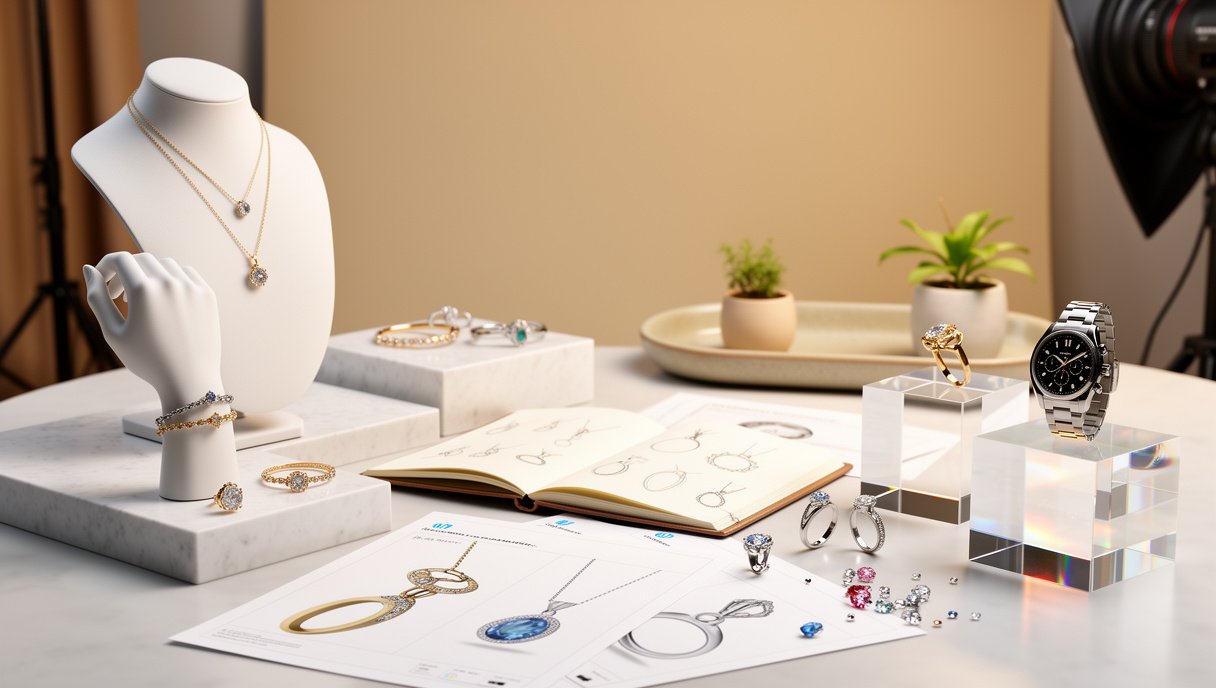
An AI-first approach streamlines this pressure. With a jewellery content creation tool, brands can start from sketches, CAD models, or existing product photos and quickly generate studio-grade packshots, lifestyle scenes, and on-model imagery. Instead of building lighting rigs for reflective metals and stones, virtual studios simulate softboxes, scrims, and reflectors to capture the signature gleam of polished gold, the brushed warmth of platinum, or the fire in pavé diamonds. Output settings ensure assets are 2K and 4K for zoomable PDPs and print-ready lookbooks, while templates keep framing, horizons, and shadows uniform across SKUs.
Speed becomes a strategic advantage. Merchandisers can test price points with visuals before inventory arrives. Designers can validate materials by previewing how a piece renders in rose gold versus white gold, or how a sapphire halo reads under cool lighting compared to warm. Social teams can adapt hero images for reels, carousel posts, and ad formats with a few clicks—without rebooking models or scouting locations. Better still, if product specs shift late (a clasp changes, a stone size adjusts), the imagery can be updated in minutes rather than reshot, minimizing waste and preserving momentum.
Crucially, this approach doesn’t trade speed for quality. Intelligent material models, realistic contact shadows, and precision reflection control help ensure every prong, bevel, and micro-engraving is represented faithfully. When integrated thoughtfully into the brand’s asset pipeline, a single Jewellery content creation tool can become the engine that powers omnichannel content from concept to campaign, without compromising craftsmanship.
Key Features to Look For: From CAD and Sketch to Photo-Realistic Campaigns
Not all tools are built for high-end metals and gems. Jewellery poses unique challenges: extreme reflectivity, complex refractions, and small components that must remain crisp at high resolutions. Look for a platform that ingests multiple sources—sketches, CAD files, and product photos—so creative teams can jump in at any stage. Strong physically based rendering and material intelligence are essential for gold, silver, platinum, enamel, pearls, and diamond-like stones. True-to-life modeling of index of refraction, dispersion, and surface micro-roughness helps capture the distinct sparkle and depth that jewellery buyers expect.
A drag-and-drop studio accelerates scene building with lighting presets, HDR environments, and macro-friendly cameras tailored to rings, necklaces, earrings, bracelets, and watches. Look for background libraries—velvet trays, marble slabs, pedestal stones, and soft linens—that suit luxury aesthetics, plus the ability to import brand-specific backdrops. Scene templates preserve brand standards for angles, scale, and shadow length so every SKU lands on the website with consistent polish. Smart editing—masking, dust removal, prong clean-up, and color balancing—keeps post-production tight and reduces reliance on external retouching.
On-model capability matters for conversion. Virtual hands, necklines, and wrists with adjustable poses, skin tones, and lighting ensure pieces sit naturally with realistic contact shadows and subtle skin reflections. Designers should be able to swap metals and stone colorways instantly, generate size variants, and preview stacked looks for cross-sell strategies. Batch rendering and 2K/4K outputs reduce repetitive work and ensure assets are printable and zoomable. Finally, brand control features—custom templates, locked guidelines, color-managed outputs, and metadata tagging—enable collaboration across in-house teams, agencies, and retail partners without losing consistency.
Real-World Workflows and Use Cases: Launch Faster, Spend Less
Consider an artisan jeweller preparing a capsule collection for a seasonal market. Early sketches are transformed into visual prototypes, letting the craftsperson test silhouettes, stone combinations, and finishes before committing to costly samples. As CADs are finalized, studio packshots and soft lifestyle scenes are generated for a presale landing page. Customer feedback guides final tweaks—perhaps a slimmer shank or a different prong style—reflected in updated renders without delaying production. When the finished pieces arrive, any micro-adjustments are integrated into the master scenes so the final assets match the product exactly. The workflow compresses weeks of photography and reshoots into days, while protecting the handcrafted story with photoreal accuracy.
For a fast-growing DTC brand running weekly drops, the challenge is scale. Dozens of SKUs need consistent angles, shadows, and backgrounds across marketplaces, PDPs, and ads. A jewellery content creation tool lets the team define a master scene for rings, earrings, and necklaces, then populate it with new SKUs via drag-and-drop. Colorway and size variants populate automatically; batch exports deliver 2K and 4K files in platform-specific aspect ratios. Social teams spin up on-model and lifestyle variations for A/B testing—jewellery on a velvet tray for elegance vs. sunlit marble for editorial pop—using the same base assets. If a wholesaler requests a clean white packshot set, the team exports a new sequence in minutes, maintaining consistent perspective and scale across the entire line sheet.
Enterprise and heritage watch brands face even higher bars: brushed vs. polished steel, anti-reflective sapphire crystals, ceramic bezels, and intricate dial textures must all read perfectly at macro. Launch calendars stretch across geographies, while last-minute date wheel or strap changes can derail shoots. With virtual production, hero visuals, lifestyle kits, and on-wrist images are prebuilt and saved as templates. If a strap material changes for a specific market, the swap is executed in the scene library and re-rendered quickly—no reshoots, no shipping samples to multiple studios, no production downtime. PR teams gain immediate access to print-ready files for press kits; retail partners receive brand-locked angles for their websites, ensuring every outlet displays the same premium standard. Across these scenarios, the common thread is control: creatives iterate faster, merchandising adapts on the fly, and the visual experience stays cohesive from launch teaser to in-store display.
Local boutiques and multi-brand retailers also benefit. Instead of coordinating bulk shoots several times per year, teams update visuals continuously: new consignments arrive, and imagery is produced in hours. Windows and social feeds stay fresh with lifestyle imagery matched to current city trends—rich winter palettes one week, sunlit summer tones the next—while keeping the jewellery itself consistently lit and color-accurate. For customers, this translates into trust: the same ring they previewed on mobile looks identical in-store, and the zoomed-in details match the piece they hold under the counter light.

Fortaleza surfer who codes fintech APIs in Prague. Paulo blogs on open-banking standards, Czech puppet theatre, and Brazil’s best açaí bowls. He teaches sunset yoga on the Vltava embankment—laptop never far away.